Mac mini Homelab: What to Run and What to Skip (2026)
A Mac mini works well as a homelab box for Docker containers and Home Assistant. It also handles media serving and local AI models. A regular mini PC usually wins for general-purpose homelab work.
Macky puts your Mac's terminal and screen on your iPhone. That lets you check on the box from your couch. For the basic setup, see Mac mini Home Server: Setup Guide and What to Run.
What a Mac mini runs well
Bitdoze lists Docker, Home Assistant, and media serving as common uses. XDA says Mac minis are strongest at local AI. A used M1 with 16GB can run a decently sized LLM.
| Workload | Fit |
|---|---|
| Docker containers | Good. Runs in a Linux VM on macOS. |
| Home Assistant | Common use, per Bitdoze. |
| Media serving | Common use, per Bitdoze. |
| Local LLMs | Strongest area, per XDA. |
| General homelab and Linux-native tooling | Mini PC is usually the better pick. |
Where a mini PC is the better pick
XDA's argument is that macOS isn't a server OS and Linux-native tooling is limited on it. In the r/homelab thread, one reply says a mini PC costs a fraction of the price and is more customizable.
If your plan is a pile of Linux services and nothing else, price a mini PC first. A used M1 Mac mini typically runs $300 to $450, according to XDA.
Docker on a Mac mini: what to know
Docker Desktop on Mac runs Docker Engine inside a Linux VM. A few defaults matter for a homelab:
- The VM memory limit defaults to 50% of host memory.
- Resource saver shuts the VM off when it's idle.
- amd64 images run under emulation on Apple silicon. You can enable Rosetta for this in Docker's settings.
Check on your homelab from your iPhone
Macky opens the Mac mini's own shell on your iPhone. Detach from a session and a long job keeps running while you walk away. Attach again whenever you like.
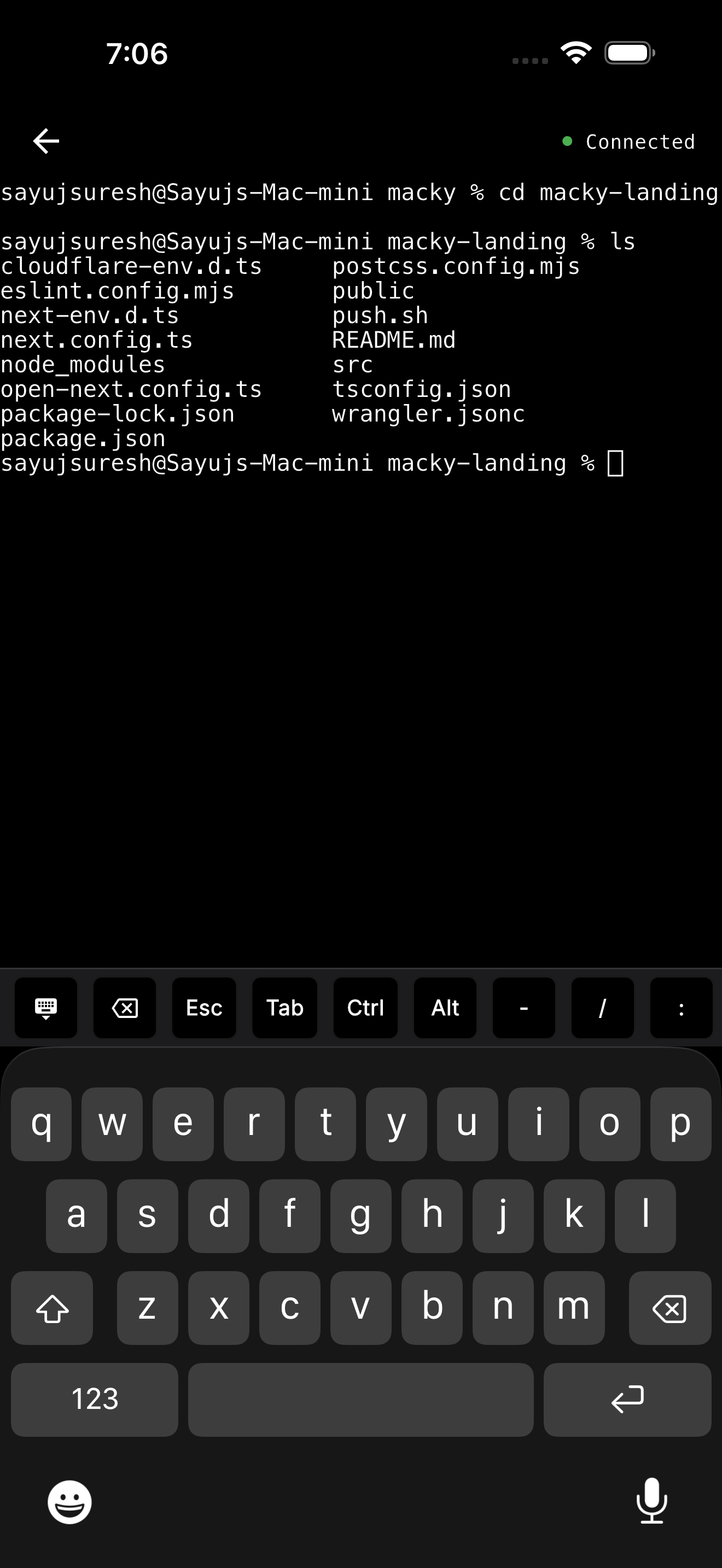
Terminal mode has a key bar. It covers Esc and Tab. It also has Ctrl and the arrow keys. Screen mode shows the Mac's desktop when a container needs a click. The connection is end-to-end encrypted with no open ports and no VPN. For container checks, see How to Manage Docker Containers on Mac from iPhone.
Keep it running 24/7
Open Apple menu > System Settings > Energy. Older macOS versions label this pane Energy Saver. These settings matter for an always-on machine:
Start up automatically after a power failurePrevent automatic sleeping when the display is offWake for network accessLow Power Mode, which Apple describes as suited to always-on machines such as servers
For one-off jobs, see caffeinate on Mac. To run without a monitor, see Mac mini Headless Setup.
RAM and storage
Memory is the first thing to size. Docker takes half by default, so containers on a 16GB Mac mini get about 8GB. Third-party outlets list 24GB and 32GB upgrades for the M6.
Storage is the second. AppleInsider's M6 review headline criticizes the base SSD as too small. Images, volumes, and media add up fast. Plan for external storage or a larger internal drive.
FAQ
Can I use a Mac mini as a home server?
Yes. People run Docker containers, Home Assistant, and media serving on one. Turn on the Energy settings listed above so it stays on.
How much RAM do I need for a homelab?
There's no authoritative number. Docker Desktop gives its Linux VM 50% of host memory by default. A 16GB Mac mini gives containers about 8GB unless you change it.
Is a Mac mini better than a mini PC for a homelab?
It depends on the workload. XDA says Mac minis are strongest at local AI, and regular mini PCs are better as general homelab machines.
Can I reach my homelab Mac mini from my iPhone?
Yes. Your Mac's shell is real, so ssh uses the Mac's own config and keys. The keys stay on the Mac and never go to the phone.
Related Guides & Comparisons
Try Macky
Connect to your Mac terminal from your iPhone.